
Industrial sulphur buyers compare on purity, and purity alone is rarely enough to place an order. Ash, acidity, moisture and particle size determine whether material suits sulphuric acid production, a fertilizer blend, rubber vulcanisation or a metallurgical process — and those parameters vary between grades that look identical on a headline number.
Apex ChemTrade supplies two distinct sulphur specifications. This page sets out both, so you can see which one your process needs before you enquire.
Two grades, two specifications
Sulphur granular / lump — 99.5% minimum, according to the supplied Venicia Chemical Industries sheet:
| Parameter | Supplier specification |
|---|---|
| Sulphur purity | 99.5% min. |
| Ash | 0.3% max. |
| Moisture | 0.2% max. |
| Acidity as H₂SO₄ | 0.1% max. |
| Size | 2–50 mm |
Granular sulphur — 99.95% minimum, dry basis, a separate specification:
| Parameter | Supplier specification |
|---|---|
| Sulphur purity (dry basis) | 99.95% min. |
| Ash | 0.03% max. |
| Acidity as H₂SO₄ | 0.003% max. |
| Moisture | 0.2% max. |
| Granule size | 0.5–6.3 mm |
Note what changes between them. Purity rises by less than half a percentage point, but ash falls by a factor of ten and acidity by a factor of thirty. For most buyers the ash and acidity figures, not the purity headline, decide which grade is appropriate.
The 99.95% specification comes from a separate sheet that does not identify its provider. Provider identity and availability are confirmed in the quotation rather than assumed here. Our comparison of the two grades explains why the two sheets should not be read as one.
Apex ChemTrade is a seller, not a manufacturer. Production and product documentation belong to the respective providers; we name them so each figure above can be traced to its source sheet.
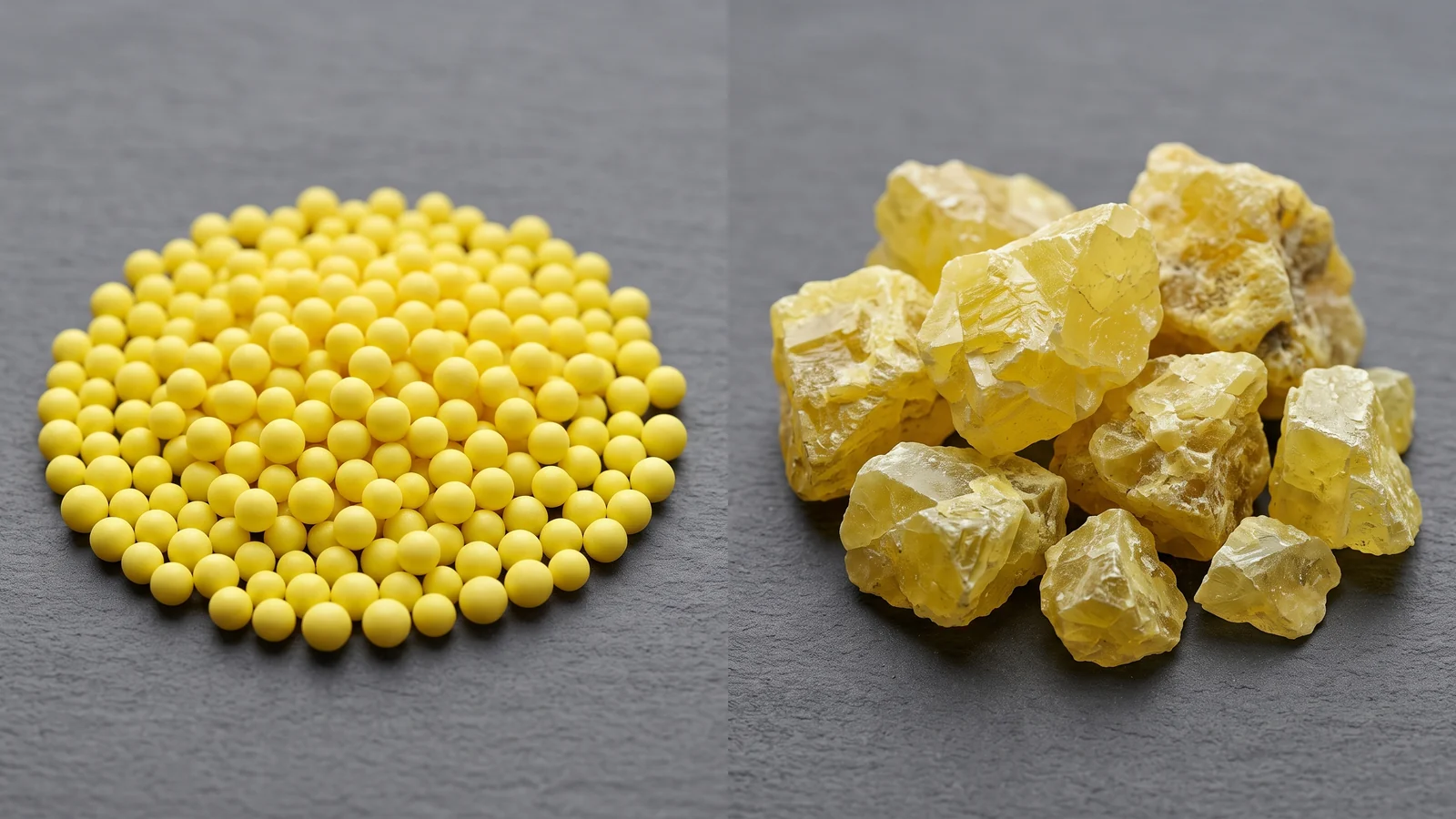
Granular or lump
Granular material handles and meters predictably, which matters for blending and for automated feed. Lump is coarser and suits processes where the material is dissolved or burned and handling consistency is less critical. Tell us the process and we will advise which form fits; if either works, that usually widens availability.
Typical applications
Sulphuric acid production, fertilizer manufacture, rubber processing, pulp and paper, and metallurgy. We do not claim suitability for a specific process on your behalf — confirm the specification against your own requirements, and we will supply the supporting documentation to let you do that.
What to include in your enquiry
- Grade — 99.5% or 99.95%, or the parameters you actually need if you are unsure
- Form — granular, lump, or either
- Quantity per shipment and frequency
- Packaging — bulk bags, sacks or bulk
- Destination — discharge port or delivery address
- Documentation — certificate of analysis, inspection, or any import-specific paperwork
What you receive
A written offer with grade, specification, quantity, packaging, delivery terms and validity, plus the provider documentation supporting the figures.
View the 99.5% specification · View the 99.95% specification · Send an enquiry
Source: product specification sheets provided to Apex ChemTrade.
Clear answers. Better decisions.
Which sulphur grades do you supply?
Two: 99.5% minimum granular or lump, and a separate granular specification at 99.95% minimum on a dry basis.
Is the 99.95% grade always better?
Not necessarily. It costs more and may offer no benefit if your process tolerates the 99.5% grade. Match the specification to the process.
Do you supply lump or granular?
Both. Granular suits blending and automated feed; lump suits processes where the material is dissolved or burned.
Who produces the sulphur?
The 99.5% specification comes from the supplied Venicia Chemical Industries sheet. The separate 99.95% sheet does not name its provider; identity and availability are confirmed in the quotation.